
After the Constitution was ratified in June of 1788, George Washington and James Madison urged the members of Congress to support the addition of the Bill of Rights, inspired by the notion that freedom of the press was essential to a functioning democracy. After reviewing and debating over 100 proposed amendments from the states in the union at the time, ten amendments would eventually be cemented as the Bill of Rights.
The First Amendment was passed by the Senate on September 25, 1789, and the House on September 24, 1789. The first ten amendments of the Constitution were approved after 11 of the 14 states in the Union approved the amendments.
The First Amendment – Free Speech
Most commonly associated with freedom of speech, this amendment intends to guard the fundamental rights of the citizens – free speech, freedom of religion, freedom to assemble, and freedom of the press.
In the Bill of Rights of the U.S. Constitution, the First Amendment reads:
“Congress shall make no law respecting an establishment of religion, or prohibiting the free exercise thereof; or abridging the freedom of speech, or of the press; or the right of the people peaceably to assemble, and to petition the Government for a redress of grievances.”
This amendment is pretty straightforward in its original text, but not all free speech is protected. Advocacy groups like the Foundation for Individual Rights and Expression (FIRE) make it their mission to protect free speech when those rights may have been infringed upon. With the invention of the internet and social media, understanding what the First Amendment means is more complicated than ever.
Due to the many complexities around this topic, the information below is shown as it is published so as to not provide my own opinion but to relay the facts that are published by the Foundation for Individual Rights and Expression (FIRE) and in the Constitution, and have been cited with the source of the text through the hyperlinks.
Freedom of speech includes the right:
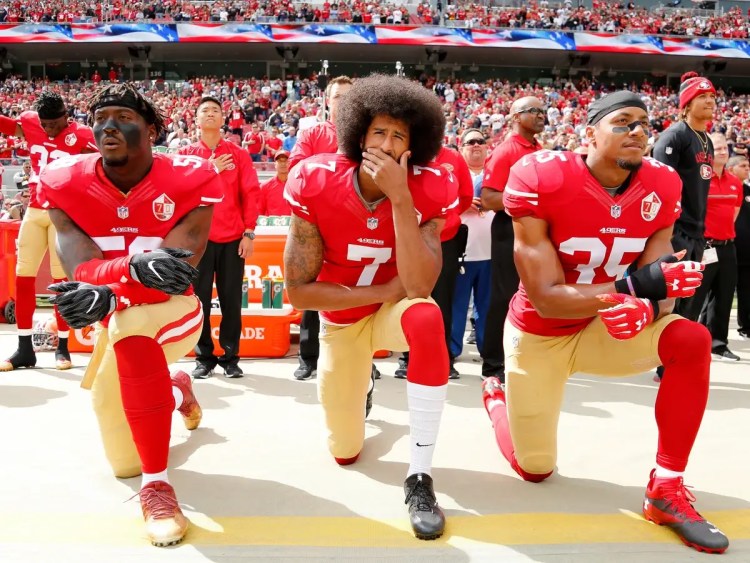
- Not to speak (specifically, the right not to salute the flag).
- To use certain offensive words and phrases to convey political messages.
- To contribute money (under certain circumstances) to political campaigns.
- To advertise commercial products and professional services (with some restrictions).
- To engage in symbolic speech, (e.g., burning the flag in protest).
Freedom of speech does not include the right:
- Incitement to imminent lawless action (incitement);
- speech that threatens serious bodily harm (true threats); or
- speech that causes an immediate breach of the peace (fighting words).
- Defamation
- Fraud and Perjury
Not all hate speech is protected by the First Amendment, since hateful expression can fall within the the previously mentioned exemptions.
Categories of Unprotected Speech
Incitement
Incitement — speech that is both “directed to inciting or producing imminent lawless action and is likely to incite or produce such action” — is unprotected by the First Amendment.
The standard comes from the Supreme Court’s 1969 decision in Brandenburg v. Ohio, a First Amendment challenge to the arrest of Ku Klux Klan members under an Ohio criminal syndicalism law. Journalists captured footage of the armed Klansmen using slurs against black and Jewish people. The Klansmen stated there “might have to be some revengeance taken” against government officials and announced a march on Congress on the Fourth of July. The Court struck down the Ohio law because the statute “purports to punish mere advocacy and to forbid, on pain of criminal punishment, assembly with others merely to advocate the described type of action.”
True Threats
In Virginia v. Black (2003), the Supreme Court defined true threats as “those statements where the speaker means to communicate a serious expression of an intent to commit an act of unlawful violence to a particular individual or group of individuals.” Importantly, the speaker does not need to actually intend to engage in violence for the government to punish threats or intimidation. Free speech is not protected when he knows of or “consciously disregard[s] a substantial risk that his communications would be viewed as threatening violence.”
That being said, true threats are distinguishable from heated rhetoric. For example, the Court held in Watts v. United States (1969) that the First Amendment protected a man’s statement — after being drafted to serve in the Vietnam War — that “[i]f they ever make me carry a rifle the first man I want to get in my sights is L. B. J.,” as the statement was not a true expression of intent to kill the president.
Fighting Words
Fighting words are those that, by the very act of being spoken, tend to incite the individual to whom they are addressed to respond violently and to do so immediately, with no time to think things over. The fighting words category is an exceedingly limited classification of speech, encompassing only face-to-face communications that would obviously provoke an immediate and violent reaction from the average listener.
Obscenity
In Miller v. California (1973), the Supreme Court outlined a three-prong standard that material must meet in order to be considered legally obscene:
- whether the average person, applying contemporary community standards, would find that the work, taken as a whole, appeals to the “prurient interest” (an inordinate interest in sex);
- whether the work depicts or describes, in a patently offensive way, sexual conduct;
- whether the work, taken as a whole, lacks serious literary, artistic, political, or scientific value.
A real-life example of a potential infringement on our First Amendment rights
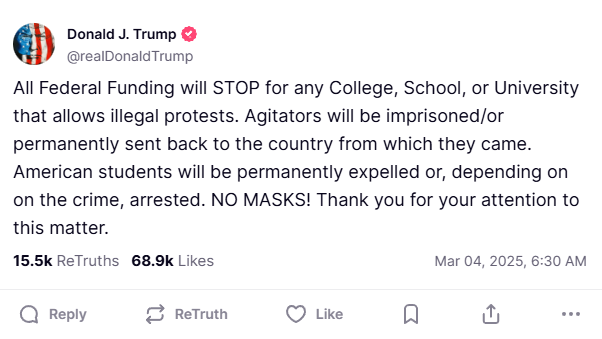
The Foundation for Individual Expression came forward with a statement on the same day Trump posted it to his Truth Social account. Read their response here: Statement on President Trump’s Truth Social post threatening funding cuts for ‘illegal protests’
The Constitution Annotated: First Amendment Fundamental Freedoms and the Complexity of Protections
Arguably, the most misinterpreted part of freedom of speech is what is protected and what is not. Beyond the defined unprotected free speech examples above, there are instances when even constitutionally protected speech could have negative repercussions. For example, there have been many people fired for what they post on social media, either what they say or how they act. While they may be protected constitutionally, employers have the right to terminate for what they deem inappropriate. So, before you post anything online, make sure to check the employee handbook you signed when you started your job to see how strict the rules are for you and what the repercussions may be.
About the Foundation for Individual Expression (FIRE)

Free Speech Makes Free People
The Foundation for Individual Rights and Expression’s mission is to defend and sustain the individual rights of all Americans to free speech and free thought — the most essential qualities of liberty. FIRE educates Americans about the importance of these inalienable rights, promotes a culture of respect for these rights, and provides the means to preserve them.
More about the Foundation
Freedom of speech is a fundamental American freedom and human right. It is essential for democracy, scientific progress, artistic expression, social justice, peace, and our ability to live as authentic individuals.
Yet, across our nation, this cornerstone of our free society is under serious threat. Far too many of us fear sharing our views or challenging those that seem to dominate. Nearly 6-in-10 Americans believe our nation’s democracy is threatened because people are afraid to voice their opinions.
FIRE therefore defends and promotes the value of free speech for all Americans in our courtrooms, on our campuses, and in our culture. Our vision is an America in which people overwhelmingly believe in the right of others to freely express views different from their own, and expect their laws and educational institutions to reflect and teach this belief.
Visit thefire.org to learn about what they do and how to get involved with protecting the most fundamental freedom that is sacred to the United States.