
The federal government determines the federal minimum wage rate. Some states adhere to the federal guidelines, while others set their own minimum wage rates. Because of this, it can be challenging for businesses with employees across multiple states to stay on top of all the minimum wage changes, especially for higher-cost-of-living states like California or New York.
Minimum Wage Guidelines
The federal minimum wage is currently $7.25 an hour. This rate has been in place since July 24, 2009, when it was increased from $6.55 an hour. The federal rate serves as the absolute lowest minimum wage allowed nationwide. Still, each state can set its minimum wage for workers, and sometimes, minimum wages per county within a state. State minimum wage rates are typically governed by the state legislature, which needs a majority to approve the measures. Click on the image to get to the sources by state, which may update if new legislation is passed.

Many red states, including Texas, Georgia, West Virginia, Indiana, North Carolina, South Carolina, Alabama, Tennessee, Louisiana, Mississippi, Oklahoma, Kansas, Utah, have yet to legally change the statewide minimum wage to one that is higher than the federal one.
Alaska, Arizona, California, Colorado, Connecticut, Delaware, Illinois, Maine, Michigan, Minnesota, Missouri, Montana, Nebraska, New Jersey, New York, Ohio, Rhode Island, South Dakota, Vermont, Virginia, and Washington raised their minimum wage on Jan. 1, 2025.
The $25 Minimum Wage was the rumor, but Trump Treasury Secretary Scott Bessent says “no” to raising $7.25 minimum wage.
The federal minimum wage is officially a poverty wage in 2025.


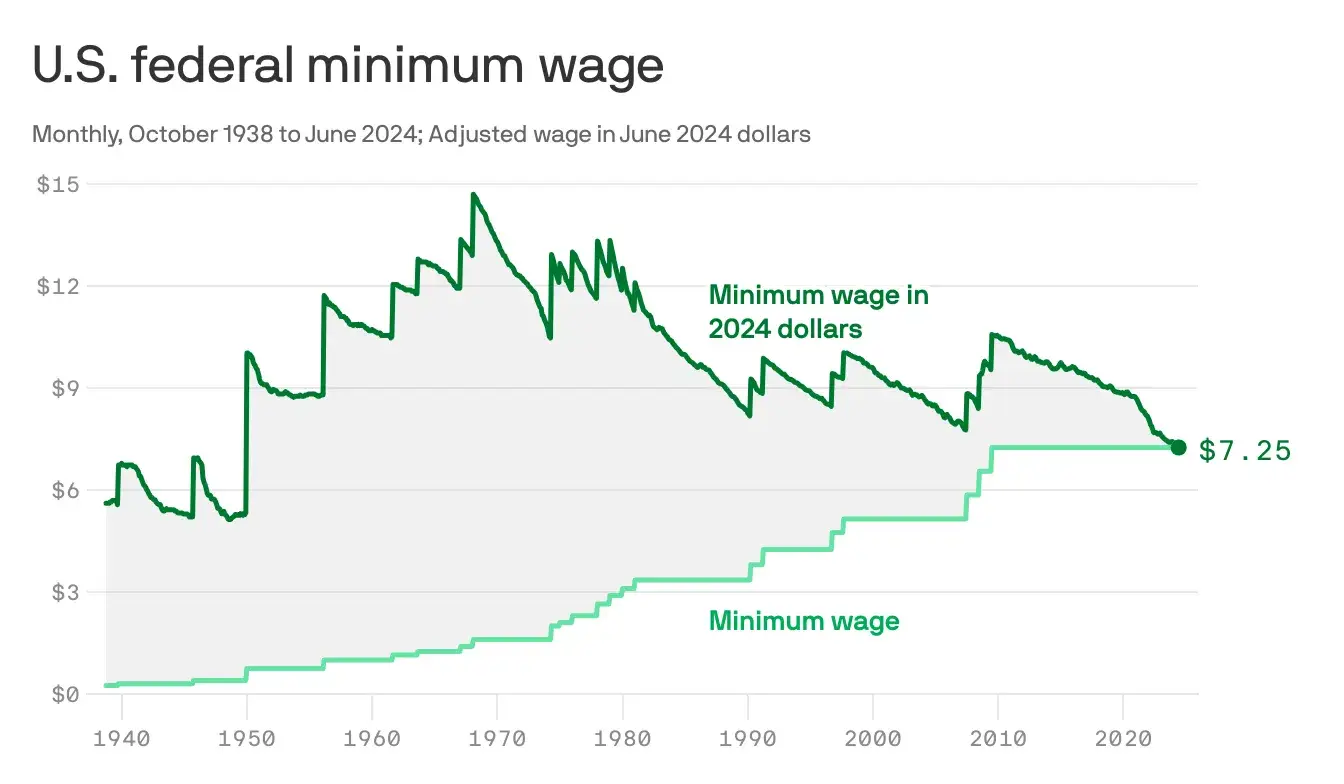
The inflation-adjusted wages showed that $1.60 an hour in 1968 equals $14.01 an hour in 2024 dollars.
The chart below shows the inflation-adjusted and non-adjusted values of the federal minimum wage from 1938 to 2024. The minimum wage’s real value has declined significantly, which is a strong indicator that $7.25/hour is not a livable wage. Meanwhile, members of Congress make $174,000 per year.
Final Thoughts
Over half of the country lives paycheck to paycheck, and a full-time, $7.25/hour minimum wage job is no longer livable. Ideally, states would take the lead in making life easier for their constituents by raising the minimum wage on their own, but in many cases, legislation has failed to pass to raise the minimum wage at the state level. The subject doesn’t gain enough traction with the public on a federal level, so minimum wage is rarely discussed as a priority of an administration taking office.
Theoretically, if the minimum wage is increased, all wages will increase to stay competitive. This will allow for a more productive and “family-focused” society, giving parents time to raise their kids instead of working two or three jobs. I look forward to celebrating the first president who can enact a federal minimum wage increase to make lives better for Americans.